
In this idea
Your welcome flow makes an introduction. Your campaign announces a sale. Your checkout reminder asks someone to finish an order. Each message can make sense on its own, yet feel clumsy when all three arrive in the same afternoon.
Inside the business, flows and campaigns often have different owners, dashboards and deadlines. The customer experiences them as messages from one brand.
Plan them together. Give each a clear job, decide what takes priority when they overlap, and judge the experience across the whole journey.
01 / EMAIL / STRATEGY
Two ways of choosing the moment.
A campaign is a scheduled send to a chosen audience: a collection launch, an editorial note, a sale announcement. A flow responds to a trigger, such as a signup or order, using delays and conditions to decide what happens next. Klaviyo’s campaign guide sets out that distinction.
The useful difference is whose moment starts the conversation. A campaign often begins with the brand’s calendar. A flow often begins with something a customer has done.
That does not make every flow personal or every campaign broad. An automated message can ignore context; a carefully selected campaign can be highly relevant. Good judgement comes from the audience and the content, as well as the mechanism that sends it.
EVERGOODS / Welcome / Detail ↗

Oura / Campaign / Detail ↗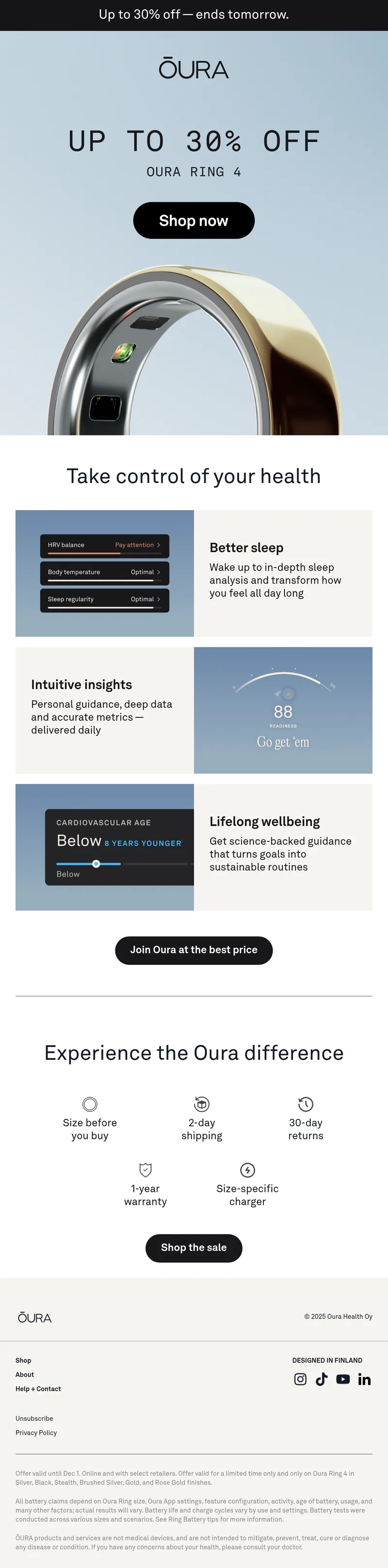
A closer look
A welcome. An occasion.
One introduces the brand after signup. The other gives an audience a timely reason to shop. These archived examples show two different communication jobs; they do not reveal the brands’ complete sending logic or results.
Email designs by EVERGOODS and Oura. View the full examples on Email Love. View the source ↗ · Oura on Email Love ↗
03 / EMAIL / STRATEGY
Decide which message deserves the moment.
Use a simple hierarchy as a planning tool. Essential order information needs to arrive. A customer asking for help needs an answer. A timely message about a decision already in progress may deserve priority over a general editorial send.
The exact order depends on the store. A launch notification someone explicitly requested may be more valuable than another generic welcome email. A product-care message may matter more than an immediate cross-sell after delivery.
Write down the rule before building the exception. For example: after a purchase, pause first-order promotions and irrelevant recovery messages; retain useful product education; reconsider broad promotional sends for a short, deliberate period.
Exclusions have a cost too. If you exclude every recent buyer from every campaign, people may miss a relevant accessory, event or restock. The goal is to remove contradictions while keeping useful messages eligible.
04 / EMAIL / STRATEGY
Build the logic around what can change.
A trigger describes what happened at entry. The customer’s situation can change while they wait for the next message. They may purchase, unsubscribe or become ineligible for the offer.
In Klaviyo, profile filters are checked at entry and before flow actions. Failing one action does not necessarily remove a person from every later step; the conditions are checked again. Its trigger and filter documentation explains the distinction.
Make the conditions match the promise. A first-order incentive needs a purchase check. A replenishment message needs to consider whether the item was bought again. An expired promotion should not survive inside a forgotten automated email.
Test people who change state midway through the journey. Previewing a template proves that it looks right; it does not prove the right person will receive it.
05 / EMAIL / STRATEGY
Frequency controls need a plan behind them.
Sending limits can reduce collisions, but they cannot decide which message matters most to your customer.
Klaviyo’s Smart Sending skips eligible messages after a recent marketing send in that channel. A skipped message is not automatically rescheduled. Email and SMS have separate windows, so an email limit does not by itself prevent a text arriving soon afterwards. Check the current Smart Sending rules and the settings on each message.
That creates a practical question: if this email is skipped, will the next one still make sense? A sequence should not assume someone read yesterday’s explanation or received an earlier code.
Before a busy period, review the combined pressure from campaigns, welcome emails, recovery messages and SMS. Change timing, eligibility or content where needed. Turning every protection off because a sale is important simply gives the customer more work to do.
06 / EMAIL / STRATEGY
Measure the job each message was hired to do.
A checkout flow reaches people already close to buying. A campaign may introduce something they had no intention of considering. Comparing their conversion rates without that context can lead to the wrong investment decision.
For flows, review entry volume, delivery, skips, useful clicks, purchases and the reasons people miss messages. For campaigns, look at audience relevance, clicks, orders and signs that attention is wearing thin. Include unsubscribes and complaints in both reviews.
Attributed revenue is shaped by tracking rules and time windows. Klaviyo explains how those windows assign message credit. That credit does not establish how much revenue would have disappeared without the message. Use a properly designed holdout test when your audience and measurement support it; until then, be careful with causal claims.
Make the review a short weekly habit:
- Check the coming campaign against every relevant live flow.
- Confirm offers, stock, exclusions and stopping conditions.
- Walk through a new subscriber’s and a recent buyer’s experience.
- Investigate unexpected skips or contradictory messages.
- Choose one improvement and record why you made it.
Flows keep responding as customers act. Campaigns give the brand something timely to say. Give both the same standard of care.
A second thought. A next step.
Bring the inbox together.
Let’s connect your campaign calendar and automated journeys.
Talk it through with us