
BFCM / Email & SMS / 001
Black Friday 2026: your email & SMS plan.
A clear offer. A considered calendar. A reason to come back after the sale.
A busy inbox needs a clear reason to buy. A good BFCM plan also gives customers a reason to come back after the sale.
It is tempting to start Black Friday planning with a list of subject lines. Or a discount. Or a design you saved six months ago. Start one step earlier: what are you asking people to buy, why should they buy it now, and what happens after that order?
That is the thinking behind our BFCM Email & SMS Playbook. Here is the shorter, practical version: a plan you can use to brief your team, build your calendar and make each send earn its place.
01 / THE OFFER
Make the deal easy to understand.
Choose the commercial job first. Are you introducing new customers to a bestseller, increasing basket size with a useful bundle, or helping previous buyers explore a second category? Each needs a different offer.
Write the offer in one sentence. Then check the details that determine whether it can work: eligible products, margin after discount, available stock, shipping thresholds, exclusions and a genuine end time. Your email, product page and checkout should tell the same story.
If explaining the deal takes a paragraph of exceptions, simplify the offer before asking design to simplify the email.
02 / THE AUDIENCE
Give every audience a different job.
An interested subscriber who has never ordered needs confidence. A repeat customer might need a new product to try. A recent buyer may need help using their purchase, rather than another prompt to buy the same thing.
Build your audiences around those differences. Start with engaged prospects, previous customers, your most active buyers and recent purchasers. Set the exclusions alongside the audience, and refresh them before a campaign goes out.
Klaviyo’s BFCM sending guide also separates campaigns by audience and uses purchaser exclusions. Our takeaway: a full campaign calendar should not become the same full inbox for every subscriber.
03 / THE CALENDAR
Plan enough sends to do the work.
For our two-week BFCM planning window, November 17–30, we recommend a minimum of six email campaigns per week for the Lean program. A High-frequency program has eight to ten per week. These are Foolish’s planning recommendations, with audience selection and account health deciding who receives each send.
| Program | Per week | Two-week total |
|---|---|---|
| Lean | 6 campaigns | 12 campaigns |
| High-frequency | 8–10 campaigns | 16–20 campaigns |
Program totals are not an instruction to send every campaign to everyone. Plan around your deliverability, stock, offer, production capacity and how much your audiences have already heard from you.
Give the calendar a sequence: build interest, introduce access, launch the offer, answer purchase objections, surface useful products, remind people of a real deadline and move buyers into the next stage. For each slot, record the audience, exclusions, message, landing page, owner and send time.
The higher cadence should give you room for more relevant audience and product stories. If you cannot explain the job of a slot, revisit it. Watch clicks, orders, unsubscribes and complaints as the program runs, and adjust the plan when the evidence changes.
04 / THE CREATIVE
Clear beats complicated.
Peak-season creative has a simple job: make a good offer easy to act on. Keep the design focused, change the rhythm with a personal note, and give relevant messages a considered second chance.
Let the offer lead.
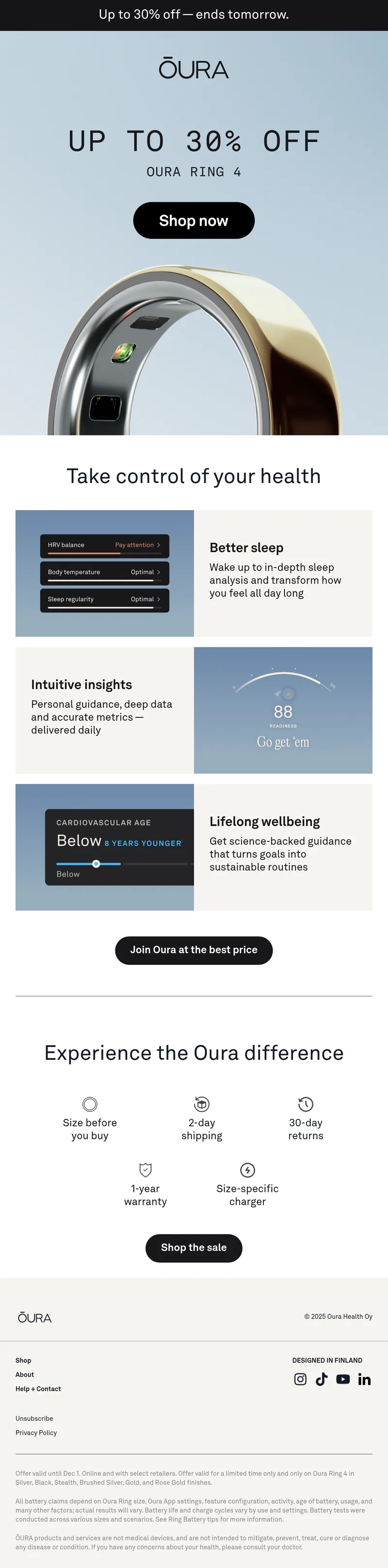
Build a short graphic email around the offer, a useful product visual and one primary action. Let someone understand what they can buy, what they save and where to go without scrolling through a brand presentation.
Simple should still look like your brand. Use recognisable typography and colour, keep the main offer and CTA as live text where possible, and add useful alt text to images. A short layout can be quick to produce without turning the whole message into an image that disappears when images are blocked.
In the example: Oura’s offer-led BFCM email on Email Love ↗. A clear discount, a direct CTA and a product close-up.
Make room for a message from a person.
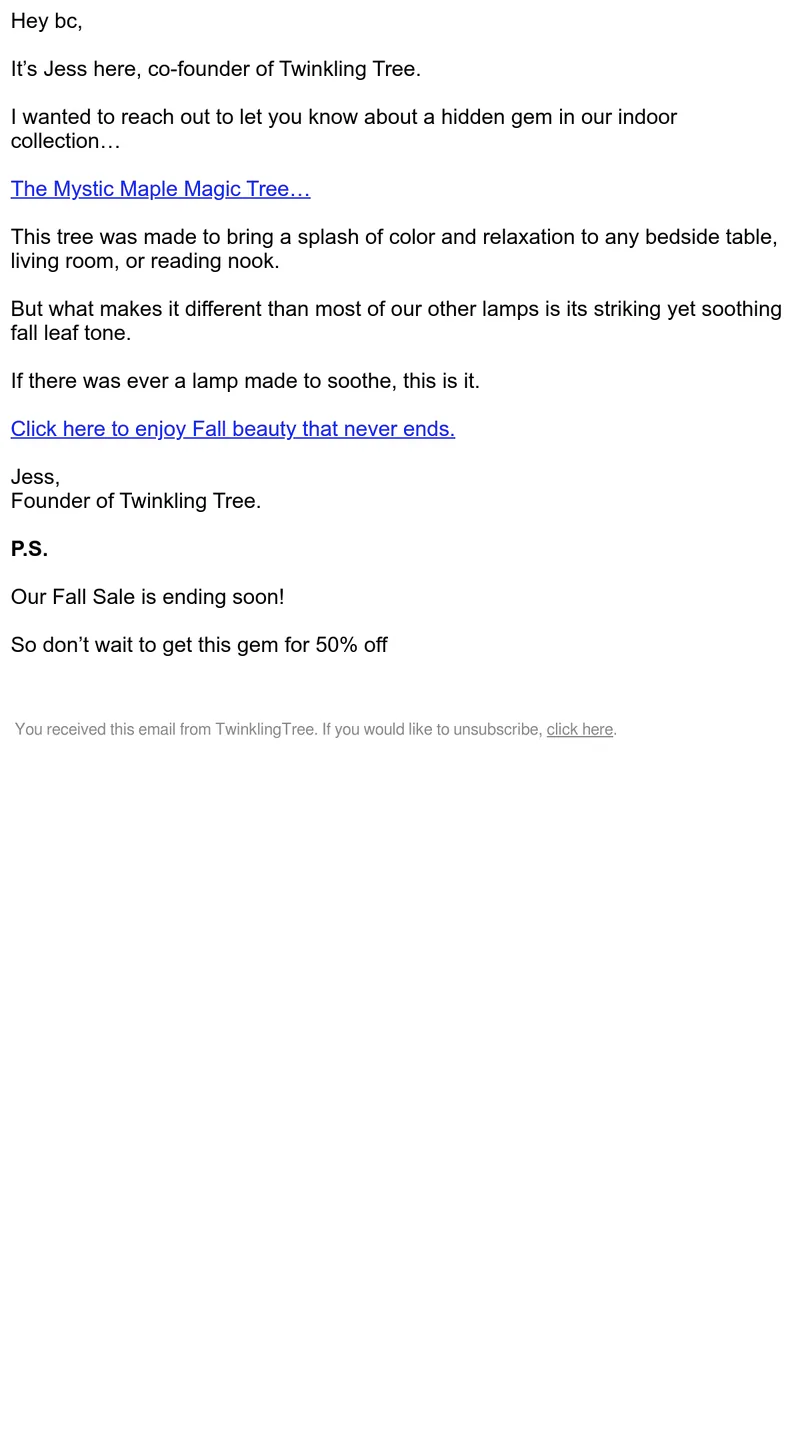
A text-led note can sit between graphic campaigns. Write in the real founder’s voice, with their approval, or use another recognisable person from the team. Keep it conversational: why you are writing, what is available, when it ends and one clear shopping link.
Use text-led emails for a heads-up, a useful recommendation or a sincere final reminder. Keep the sender identity honest and the unsubscribe link easy to find. “Personal” is a tone, not a disguise.
Test the format with your audience. A plain-text note or a simple graphic is a creative option, not a guaranteed winner. Compare clicks and purchases alongside unsubscribes and complaints.
In the example: TwinklingTree’s co-founder note on Email Love ↗. Short paragraphs, ordinary links and a human sign-off.
A second send.
A first principle:
keep it relevant.
05 / THE SECOND CHANCE
Reuse the message. Reconsider the audience.
You do not need a completely new design for every calendar slot. A relevant offer can have a second chance with a different subject line and preview text.
Make that a selective resend, with a real reason and an appropriate gap. Check that the offer, inventory and deadline are still accurate. Exclude people who purchased, and consider excluding people who clicked or already received another message covering the same job. Count the resend inside the planned cadence; replace a slot instead of automatically adding another one.
“Did not open” is an imperfect audience definition. Apple Mail Privacy Protection can inflate opens, so use the platform’s privacy-aware engagement controls and consider recent clicks, browsing and purchase activity too. See Klaviyo’s explanation of privacy opens.
Klaviyo’s follow-up email guidance restricts resends to recently engaged profiles. A missed message is a useful opportunity. A long-unengaged address is a different problem. Avoid turning a resend into a reason to mail your entire inactive list.
06 / THE CONNECTED JOURNEY
Your campaigns do not run alone.
Someone can receive a campaign and trigger a browse, cart or checkout flow on the same day. Review the automated journey before launch: welcome, browse abandonment, cart and checkout recovery, and post-purchase.
Check discounts, links, timing and purchaser exclusions. A welcome email should not advertise an expired deal. A recovery email should not contradict the price at checkout. A new customer should not receive a generic acquisition reminder immediately after ordering.
Give SMS a specific role.
Use SMS for a moment that benefits from immediacy: agreed early access, a launch reminder or a meaningful last opportunity. Send only to people with the required SMS permission and honour applicable timing and opt-out rules. Email consent is not SMS consent.
Put both channels on one calendar. Decide where SMS adds something and where it simply repeats the email. More channels should help the customer, not just multiply the noise.
07 / AFTER THE SALE
Plan for the next order now.
The first post-purchase job is to help someone feel good about what they bought: delivery expectations, setup advice, useful product care or a way to ask for help. Time it around the real experience.
Then earn the next purchase. That could mean a complementary product after the first one has arrived, replenishment when the customer is likely to need it, or an introduction to another category. A second discount is only one option.
When reviewing BFCM, separate first-time and returning buyers. Look at order value and profit alongside revenue. Follow the BFCM customer group into the weeks ahead and measure how many return, what they buy next and where the journey breaks.
Before the first send
- One clear offer, checked against stock and margin.
- Audiences and exclusions attached to every campaign.
- A two-week calendar with owners and genuine deadlines.
- Graphic, text-led and selective resend slots with distinct jobs.
- Flows and SMS checked against the same plan.
- A helpful post-purchase journey ready to go.
Stay hungry for the next opportunity. Stay curious enough to question the obvious play. The point is to make the sale useful for the customer—and give that relationship somewhere to go.
The free PDF guide
Put the plan on paper.
Get the full BFCM Email & SMS Playbook, with the campaign plan and five fillable planning worksheets for your team.
By subscribing, you agree to receive Foolish’s latest news, product updates and occasional special offers by email. We’ll also email you the guide. You can unsubscribe at any time.
A second pair of eyes
Have a plan. Need a hand?
We can help connect your offer, campaign calendar and customer journey.
Book a callBy Foolish · Published 9 October 2026
Email examples are credited to their respective brands. Campaign recommendations and analysis are Foolish’s; further reading is linked where used.
← More Foolish Ideas