

In this idea
You can recognise a beautifully designed email in a second. Recognising a good retention marketer takes a few better questions.
Why this customer? Why this message? Why now? What happens after the click?
The work brings together commercial judgement, customer understanding, creative skill and careful execution. You do not need to be the best person in the room at all four. You do need to understand how they affect each other. That matters whether you are building a career in retention or choosing someone to run it for your brand.
01 / People & practice
Know what makes an order worthwhile.
A retention marketer should be interested in the product, the margin and the reason people buy again.
Consider a hypothetical skincare brand with a bestselling cleanser. A discount on a second cleanser might bring the next purchase forward. A useful routine guide could help someone use their first bottle properly. A complementary product might make sense for a different customer. Those are three different jobs, with different costs and timing.
Before proposing the campaign, ask about typical time between orders, stock, returns and the economics of the offer. A larger order is not automatically a better order once discounts and fulfilment enter the picture.
In a portfolio, show the decision behind the work. Explain why you chose the offer, who it served and what information would make you change your mind.
02 / People & practice
Get curious about the gaps.
The most useful retention idea may start in a support conversation.
Customers asking how to assemble something need a clear answer. Customers whose delivery is delayed need an accurate update. Someone buying a durable wallet may need a gift idea months later, rather than a replenishment reminder next Tuesday.
Map the moments after the purchase: order, delivery, first use, any problem, then the next plausible need. Talk to the people who hear from customers. Read reviews, returns reasons and replies. Look for the gap between the experience promised and the experience delivered.
For an interview exercise, sketch a journey for one real product. Identify one moment where communication could help and one where the product or service itself needs fixing. Explain what you would ask the team before building anything.

A closer look
Leave the working in.
A useful portfolio shows how you got from a customer problem to a message. Make the brief, the journey and the choices visible alongside the finished creative.
Original AI-generated editorial illustration by Foolish.
03 / People & practice
Make the idea easy to get.
Good creative judgement includes knowing what to leave out.
Can a reader understand the offer without decoding a clever headline? Does the product image answer a question? Does the page behind the button continue the same story? Would the message still make sense if its images failed to load?
Show range in your portfolio: a clear product email, a useful educational message and a short personal note. Give each a specific audience and purpose. Explain the choice of format instead of presenting three attractive screenshots without context.
You can use speculative work if you label it clearly. Name the assumptions, keep the brand's voice recognisable and never attach invented performance numbers. A thoughtful explanation of an untested idea is more useful than a fictional victory.
TwinklingTree / Founder note / Detail ↗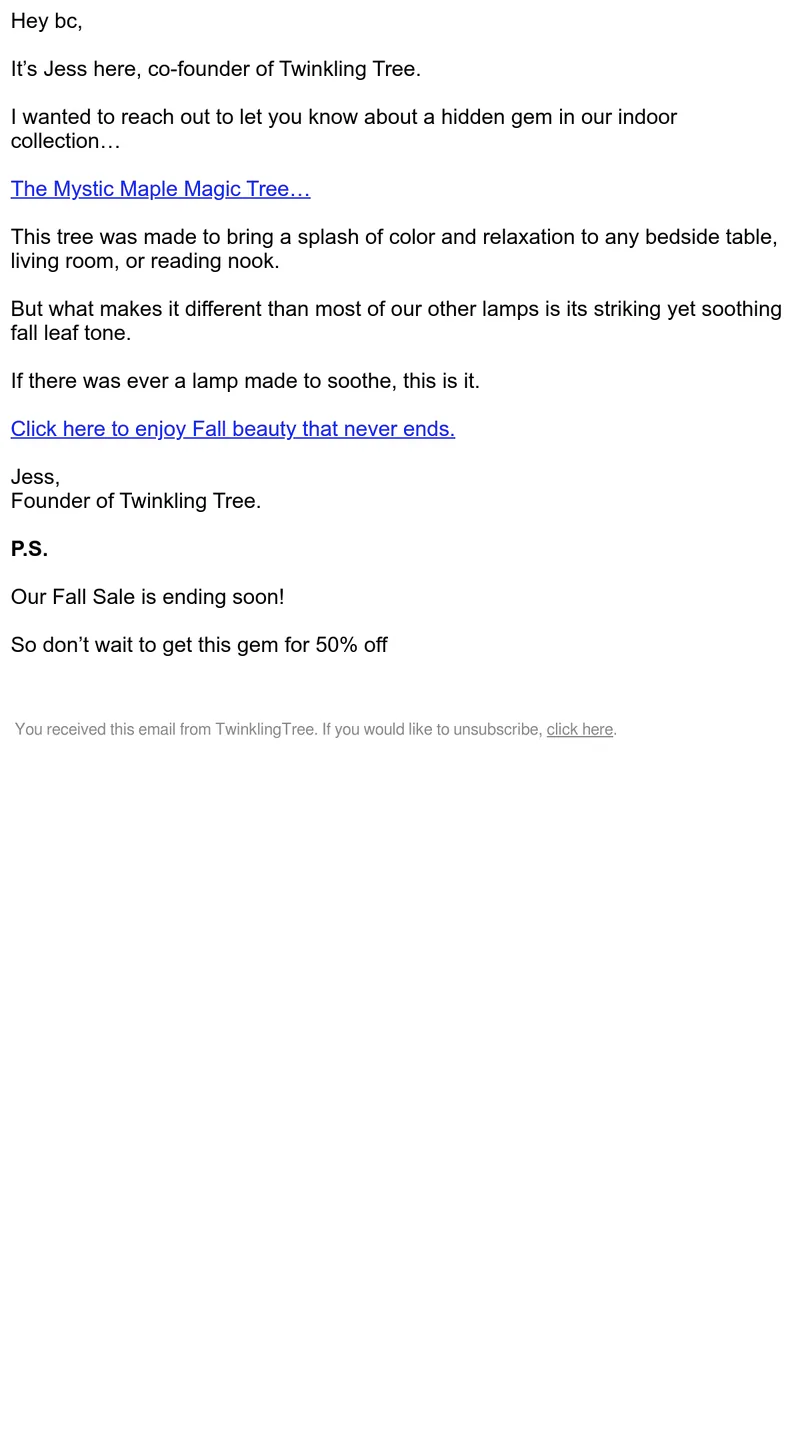
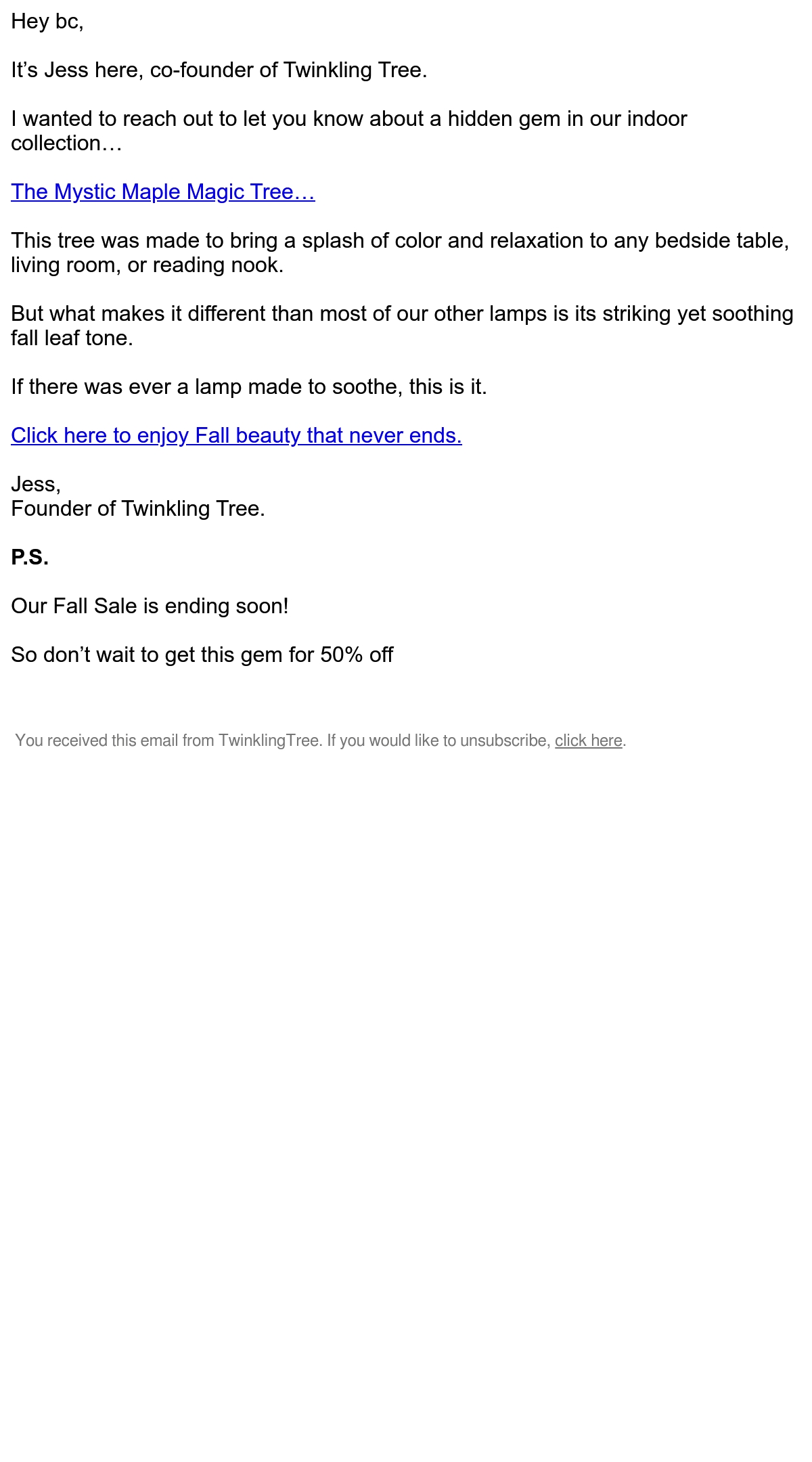
A closer look
Craft can be quiet.
TwinklingTree’s founder note is a useful contrast to a heavily designed campaign. The visible choices are short paragraphs, ordinary links and a recognisable human voice. A strong portfolio explains why that approach fits the moment.
Email by TwinklingTree, archived by Email Love. View the source ↗
04 / People & practice
Understand how the work reaches people.
Deliverability deserves a place in the creative conversation. A bigger send is not a sensible default when the audience does not want it.
Know how permission is collected, how people leave the list and what happens to invalid addresses. Understand authentication well enough to spot a missing setup or bring in a specialist. Watch delivery failures and complaints alongside campaign results.
Google's sender guidelines include authentication requirements, with additional requirements for bulk senders, including one-click unsubscribe for marketing messages. These are practical foundations worth checking against the current guidance.
A useful portfolio addition is a short pre-send checklist and an example of an issue you would escalate. You do not have to claim expertise in every technical detail to demonstrate responsible judgement.
05 / People & practice
Be precise about what the numbers say.
A good report should help someone make a decision. Start with the question: are more first-time customers buying again, is a product creating repeat demand, or is a particular message helping people choose?
Open rates need care. Apple's Mail Privacy Protection can download remote content in the background regardless of whether the person engages. A recorded open therefore cannot always tell you that somebody read the email.
Use several views. Look at clicks and orders, complaints and unsubscribes, then customer behaviour over time. Shopify's customer cohort report can group customers by first-order date and show subsequent purchases. Compare groups at the same age; a six-month-old group has had longer to return than last month's buyers.
Be equally careful with attribution. An order credited to a message is not proof that the message caused it. State the reporting window and competing explanations. If the opportunity and audience size justify it, propose a properly designed holdout test. If the evidence is limited, say what you can and cannot conclude.
06 / People & practice
Make careful execution part of the craft.
The last ten minutes before launch can undo a good week of thinking.
Check the actual audience, exclusions, timing, product availability and offer conditions. Test links and personalisation fallbacks. Read the email on a phone. Follow the complete journey through the destination page. Check whether an automated message will arrive alongside the campaign.
Good operators make this work repeatable. They leave clear briefs, record changes and flag dependencies early. When something goes wrong, they explain the impact and the next action without hiding behind a dashboard.
For a brand director, ask a prospective partner to walk through their launch checks. For a candidate, include a tidy handover or test plan. The unglamorous work is evidence too.
07 / People & practice
Build a portfolio someone can question.
Choose two or three pieces of work and give each a useful story:
- The customer problem and business context.
- The evidence available, including what was missing.
- Your recommendation and the alternative you rejected.
- What you built, checked and measured.
- What happened, what remains uncertain and what you would try next.
Be clear about your own contribution when a team did the work. Remove confidential information and get permission before sharing client material.
You can practise this without a client roster. Audit a public customer journey, build an explicitly hypothetical brief and show your reasoning. Make space for questions. The ability to revise an idea after learning something new is part of the skill.
Stay hungry. Stay foolish. Bring a point of view, and enough curiosity to give it a second thought.
A second thought. A next step.
Keep asking better questions.
Explore how we approach the work, then bring a second thought to your next brief.
Our approach